

When to use this page
Use this when you want to refresh one number: the downward load your loaded trailer puts on the coupling. Depending on your region this is tow ball mass (AU), nose weight (UK), or tongue weight (US). This is the right path when you have taken a reading from a home ball scale and want to keep your trailer’s coupling weight and compliance context up to date between professional weigh-ins. Saving the value updates your trailer’s coupling weight and the related compliance state, then refreshes your Rig Score the next time you open the Rig tab. It is not a professional weigh-in. The reading does not appear in your weigh-in history, and it does not become an active baseline. If you want a full measured record that can become your active baseline, see record a weighbridge or mobile-weigher weigh-in instead.A ball scale captures one coupling-weight value. It does not replace a full measured report from a weighbridge or truck scale, and it cannot give you axle splits or a gross weight.
Open the tow-ball weight sheet
The coupling-weight update opens as a quick sheet, so you do not work through the full weigh-in form. You can reach it from a few places:- The hitch quick action on the Rig tab.
- The trailer profile in your garage.
- Tapping the coupling point on the Rig hitch view.
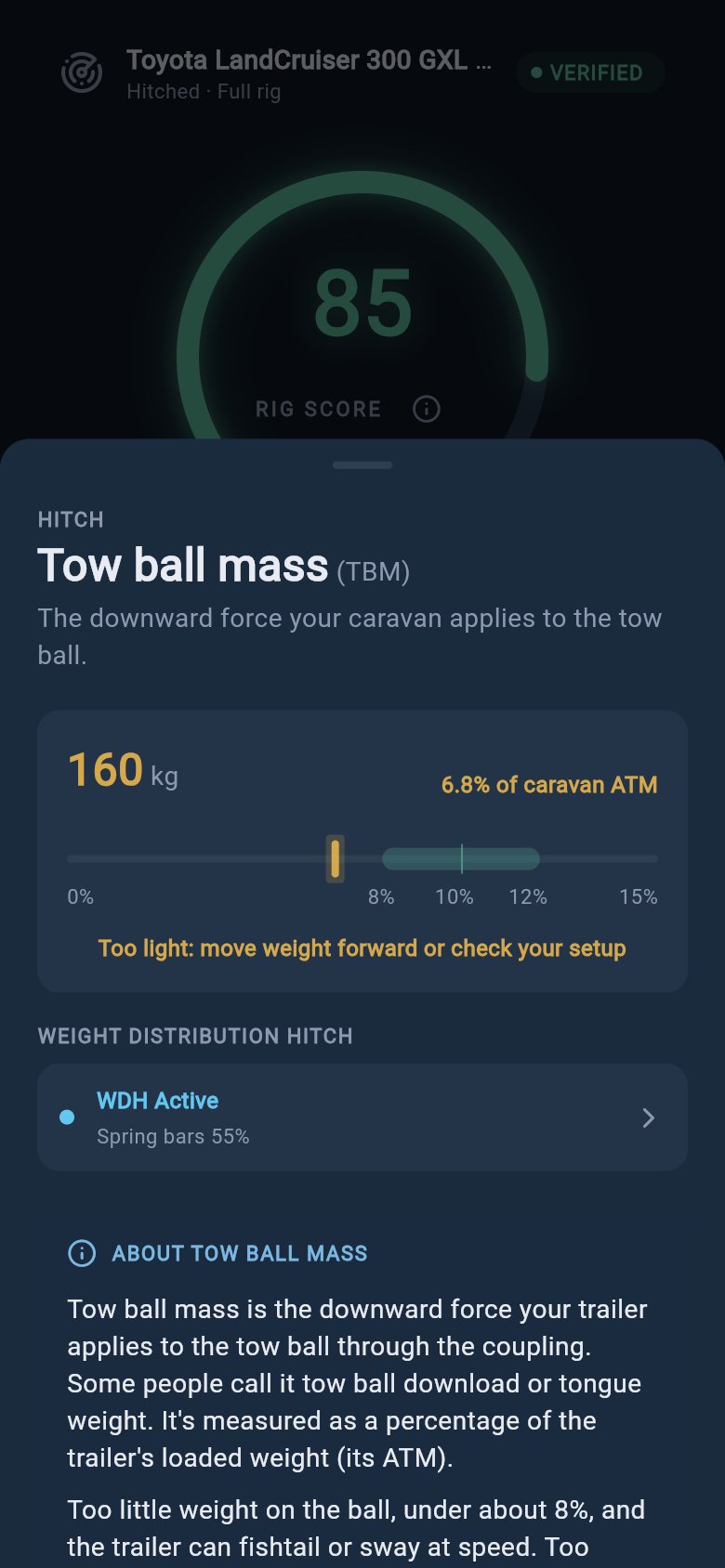
Use the right regional label
The sheet uses your region’s term for the coupling weight, so the figure on screen matches the figure on your hitch sticker:- Australia: tow ball mass (TBM)
- United Kingdom: nose weight
- United States: tongue weight
Enter the scale reading
Load the trailer the way you normally tow it, take the reading from your ball scale, then enter that value into the sheet. For a reading you can trust, set the ball scale on firm, level ground with the coupling at its normal tow height, the same height it sits at when hitched up. Type the figure exactly as the scale shows it; the field uses your region’s weight unit, so AU and UK users work in kilograms and US users work in pounds. Enter one reading for the coupling. You do not split it across axles or add other weights here. That detail belongs to a professional weigh-in.Save and review the score and compliance effect
When you save, loadmate updates your trailer’s coupling weight and the related compliance state, then flags your score and findings for a refresh. The next time you open the Rig tab, your Rig Score recalculates with the new figure. You do not need to run anything by hand. The updated coupling weight feeds the parts of your score that watch coupling limits and stability balance, so a changed reading can move that context up or down. We do not promise a particular score change; it depends on your new figure against your rig’s limits. To read how the score groups respond, see score bands.Saving your own coupling-weight reading requires Pro.
When to record a professional weigh-in instead
A ball scale reading keeps one number current, but it is not a calibration event. Record a professional weigh-in when you want a full measured report. A professional weigh-in, from a weighbridge (US: truck scale or CAT scale) or a mobile weigher, captures axle readings and totals, saves as a record in your weigh-in history, and can be set as your active baseline. That moves your data from estimate to measurement. A coupling-weight update does none of those things; it refreshes a single value. Use the ball scale for quick coupling-weight upkeep between visits, and a professional weigh-in when you want measured evidence and a new baseline. See record a weighbridge or mobile-weigher weigh-in and read a weigh-in report for that path.Try it now
- Load your trailer the way you normally tow it.
- Take the coupling-weight reading from your ball scale.
- Open the tow-ball weight sheet from the Rig hitch action or your trailer profile.
- Enter the value using your region’s label.
- Save, then open the Rig tab to see your refreshed score.
loadmate helps you work from the numbers you enter. Keep your source documents handy, and use a weighbridge, truck scale, or local authority when you need official evidence.